Knowledge Segmentation: Should One AI Provider Understand Your Entire Business?
The biggest AI governance risk may not be a leaked prompt—it may be one provider gradually understanding your entire organization. That's the idea behind Knowledge Segmentation.
Most corporate AI governance strategies focus on familiar controls:
- data classification,
- approved tools and use cases,
- access control,
- contractual safeguards,
- anonymization and pseudonymization,
- logging,
- data-loss prevention,
- human oversight.
All of these controls are necessary. They primarily address individual interactions: whether a particular prompt, document or dataset may be processed by an AI system.
But they do not fully address a broader architectural question:
What happens when one AI provider gradually accumulates enough context to understand how the entire organization operates?
The risk may not be the disclosure of one confidential document. It may be the aggregation of thousands of individually acceptable interactions into a coherent picture of the company—its intellectual property, strategy, systems, capabilities and weaknesses.
Protecting data is not the same as protecting understanding
Consider an organization with reasonably mature AI governance.
Employees use approved tools. Sensitive information is classified. Personal data is removed where practical. Prompts pass through safeguards. High-risk uses require additional approval.
Every individual interaction may comply with policy.
Over several years, however, the same AI ecosystem may assist with:
- software and infrastructure architecture,
- product development,
- customer proposals,
- commercial strategy,
- security incidents,
- internal procedures,
- risk assessments,
- financial planning,
- management decisions.
No single prompt exposes the whole business. Together, they may reveal substantially more.
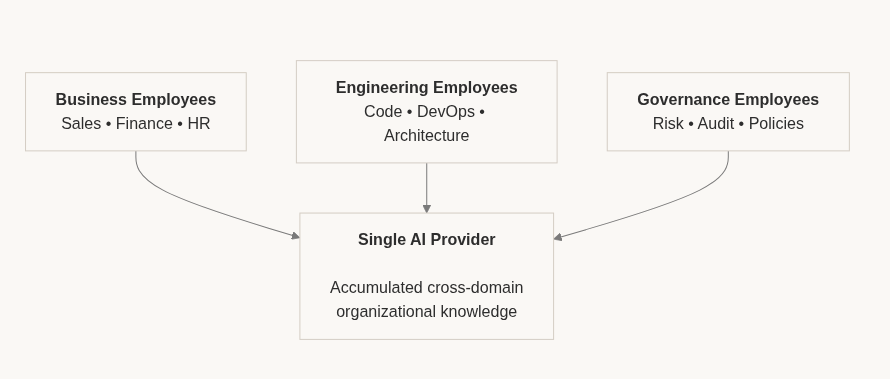
The result is not necessarily a traditional data leak. It is the gradual creation of an external representation of the organization: how it thinks, operates, competes and solves problems.
That accumulated understanding may be difficult to measure, detect or prove. This does not make the risk irrelevant.
Security architecture routinely addresses risks before they become observable incidents. We do not wait for a privileged administrator to misuse access before introducing segregation of duties. We reduce unnecessary concentrations of trust because ownership, jurisdictions, regulations and business models can change.
The same reasoning should be applied to AI.
This is not an argument against frontier AI
One possible response would be to prohibit external AI services and require all inference to remain on-premises.
For many organizations, that is not realistic.
Locally deployed models can already handle useful lower-complexity tasks, such as:
- basic summarization and rewriting,
- document classification,
- metadata extraction,
- internal knowledge retrieval,
- policy checks,
- routing and detection of sensitive content.
Frontier SaaS models, however, may still provide substantially better results for complex reasoning, high-quality writing, software engineering, advanced analysis and agentic workflows.
A company that refuses to use them under all circumstances may protect confidentiality at the cost of speed, quality and competitiveness.
The practical objective should not be to eliminate frontier AI. It should be to use it selectively without allowing one provider to become the default recipient of the organization’s complete body of knowledge.
The local LLM as a controlled gateway
A locally deployed LLM can serve two functions.
First, it can process routine and lower-complexity tasks directly. Information remains within the organization, costs are reduced and routine workloads do not need to leave the controlled environment.
Second, it can operate as a gateway to approved frontier models.
Instead of employees and applications communicating directly with SaaS providers, requests pass through a locally governed AI layer. Depending on the implementation, this layer can:
- authenticate the user and determine their role,
- classify the request and its information,
- detect restricted or unnecessary data,
- remove or replace identifiers,
- apply organizational safeguards,
- decide whether local inference is sufficient,
- select an approved external provider,
- limit the context sent externally,
- validate the returned answer,
- retain the required audit evidence.
For simple tasks, the local model answers directly.
For tasks requiring stronger inference, it forwards only the necessary context to an approved frontier service.
The local model does not need to reproduce the frontier model’s reasoning capability. Its primary purpose is to control the interaction around it.
This creates a hybrid architecture that acknowledges both confidentiality risk and the business need to remain competitive.
Segmenting knowledge by organizational function
Many organizations currently govern AI through catalogs of approved use cases.
This can work initially, but it becomes difficult to maintain. Use cases evolve quickly, overlap and combine.
A task that begins as summarization may become analysis, decision support or an agentic workflow.
Organizational functions are generally more stable.
Instead of governing every possible interaction independently, an organization can establish a small number of AI knowledge domains aligned with its operating model.
For example:
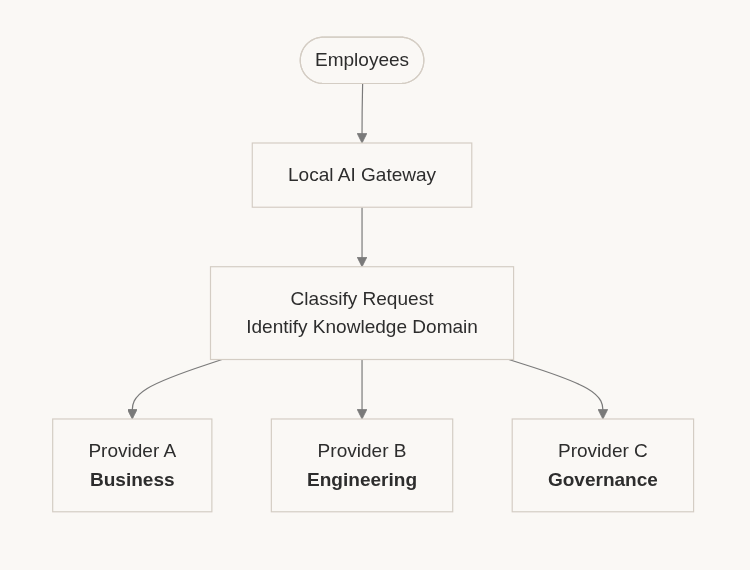
Business and commercial
This domain may include sales, marketing, finance, partnerships, customer communication and business strategy.
Its provider may understand how the company competes and sells, but it does not necessarily need source code, detailed vulnerabilities or internal security tradecraft.
Governance and assurance
This domain may include policies, risks, controls, compliance, audit preparation, asset information and management-system documentation.
It may require visibility across several functions, but that access should be explicitly defined rather than inherited by default.
Engineering and product
This domain may include source code, architecture, infrastructure, DevOps, CI/CD, product design and technical documentation.
It may use the provider with the strongest engineering capabilities. That provider does not automatically need access to commercial plans, HR information or the complete governance environment.
Different providers, accounts or strongly isolated environments can be assigned to these domains.
The objective is not perfect isolation. That could become operationally counterproductive.
The objective is to prevent unnecessary knowledge concentration.
One corporate interface can still use multiple providers
A multi-provider architecture does not need to make AI usage more complicated for employees.
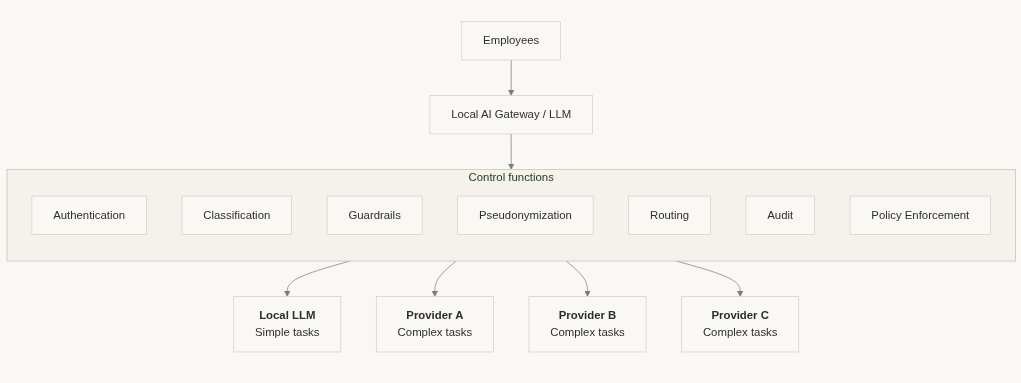
Users can interact with one corporate AI interface. The local control plane can determine:
- whether the request can be handled locally,
- which knowledge domain it belongs to,
- what information may leave the organization,
- which provider is approved for that domain,
- which safeguards and logging requirements apply.
This is consistent with other enterprise controls. Users do not manually choose network segmentation rules, identity federation paths or encryption protocols. They use a corporate service whose architecture applies those controls on their behalf.
What could excessive knowledge concentration affect?
This model does not assume that AI providers currently misuse customer information.
It considers what could become possible if one external environment accumulated a sufficiently complete representation of an organization.
Potential impact scenarios include:
Provider compromise
A cyberattack, insider threat or administrative compromise could expose not only individual interactions, but strategically useful patterns collected across multiple functions.
Legal or governmental compulsion
A provider may be subject to legal obligations within its jurisdiction. Those obligations and jurisdictions may change over time. The relevant question is whether that provider should hold enough context to reconstruct significant parts of the organization’s operations, strategy or intellectual property.
Strategic inference
Even when direct identifiers are removed, repeated interactions may reveal product direction, investment priorities, technical maturity, customer types, internal constraints and recurring weaknesses. The concern is not limited to disclosed records. It includes what can be inferred from accumulated context.
Ownership and business-model changes
Providers can be acquired, restructured or required to change their operating model. Current contractual protections do not eliminate every long-term dependency.
Lock-in
The more organizational knowledge, integrations and workflows accumulate around one provider, the harder it becomes to replace it. Confidentiality risk and strategic dependency begin to reinforce each other.
Cross-domain access should be a deliberate decision
Knowledge segmentation should not become an absolute rule.
Some AI capabilities may legitimately need to work across multiple organizational domains. A system supporting enterprise risk analysis, strategic planning or company-wide assurance may require broader context than a coding assistant or sales copilot.
The important distinction is intentionality.
Cross-domain access should be:
- justified by a defined business function,
- limited to the domains genuinely required,
- approved as a privileged capability,
- protected by stronger access and monitoring controls,
- periodically reviewed,
- supported by clear retention and exit arrangements.
The principle is therefore not that no AI provider may ever see more than one domain.
It is that no provider should gain cross-domain visibility merely because it became the organization’s convenient default.
The broader the knowledge scope, the stronger the justification and control requirements should be.
A complementary layer of AI governance
Knowledge segmentation does not replace data governance, access control, anonymization, contractual protection or technical safeguards.
It complements them.
Traditional controls attempt to make each interaction acceptable. Knowledge segmentation limits the potential consequences if those controls, assumptions or trust relationships eventually prove insufficient.
A practical enterprise architecture may therefore combine:
- local models for routine and lower-complexity work,
- a locally controlled gateway for classification, safeguards and routing,
- frontier SaaS models where advanced inference creates material value,
- knowledge domains aligned with stable organizational functions,
- separate providers or isolated environments where concentration risk justifies them,
- explicitly approved cross-domain AI capabilities.
The objective is not perfect confidentiality.
It is controlled exposure while preserving access to the AI capabilities required to compete.
The strategic question
Most organizations are currently asking which AI provider offers the best model, contractual protection or price.
Those questions remain relevant.
But they may not be sufficient.
A more strategic question is:
How much of our organization should any single AI provider be allowed to understand?
For decades, security architecture has distributed privileges, separated duties and reduced single points of trust.
As AI becomes embedded in how companies design, decide and operate, the same principles may need to be applied to organizational knowledge.
The future of enterprise AI may not belong to the organization that selects one perfect provider.
It may belong to the organization that knows what to keep local, what to externalize, which provider should see each domain—and when cross-domain visibility is sufficiently valuable to justify the risk.