
Cyber Deception Evolving Against Agentic AI
As offensive AI agents learn to recognize traditional traps, defenders are moving toward realistic decoys, misleading context, and containment built into the attack path.

1. When the attacker recognizes the trap
A honeypot once needed to look plausible to a human scanning a network. Increasingly, it also needs to survive an AI agent that checks protocol behavior, tests whether commands have lasting effects, and compares what it sees against known deception products.
That sounds like the end of cyber deception. It isn't. It changes what deception needs to achieve.
The old model was straightforward: expose an attractive fake asset, wait for a suspicious interaction, and raise an alert. The emerging model is more ambitious. A defender can change the path an autonomous attacker follows: divert it into a credible clone, feed it misleading but plausible information, induce it to validate a decoy credential, or steer it away from a genuinely valuable asset.
The distinction matters because offensive agents can work through many candidate targets at low marginal cost. If something looks false, they may simply move on. A decoy must therefore be credible where it matters, and the defensive outcome must be clear: detect, divert, delay, deter, or contain.
The studies discussed below provide encouraging experimental results, not proof that one technique will stop all agentic intrusions. Their real value is showing how the attacker's workflow can be influenced.
2. Why traditional deception is losing its edge
2.1. Prompt-injection traps are becoming less reliable
Some early agent-focused traps hid instructions inside content the attacking model was likely to read. The hope was that the model would treat an untrusted server response as an instruction and derail its own operation.
The Mantis research reported strong laboratory results for this approach. But more recent research suggests the technique is brittle against models trained to separate data from instructions. The Say Shibboleth study also found injected instructions unreliable against frontier models. Failures have a second cost: an unusually directive response can expose the trap.
This is not evidence that prompt injection has ceased to work. Results differ substantially across models and settings. It is evidence that a deception strategy built entirely on the attacker obeying malicious text is fragile.
2.2. Agents test whether the environment is real
A traditional low-interaction honeypot may reproduce a login prompt or a limited command interface. An agent can ask harder questions: does the protocol behave correctly, does a file change persist, and does an apparently successful action change the application state?
A September 2026 study demonstrated agents using these kinds of checks to distinguish honeypots from real targets. The experiments were limited, but the weakness is fundamental: imitating the appearance of a system is not the same as reproducing its behavior.
2.3. Public canaries can become recognizable
Widely shared deception tools create widely shared signatures. TruffleHog documents how certain public canary AWS keys can be identified without triggering them. An attacker agent using such a scanner may bypass the decoy before the defender sees any interaction.
This does not invalidate honeytokens. It argues for private tokens, deployment-specific designs, and testing whether the tools an attacker would use can identify them offline.
2.4. Automation changes the economics of suspicion
An attacker exploring a thousand targets may prefer skipping a suspicious one to proving it is safe. The question is not always “can the agent defeat this decoy?” but “is spending more effort on this target worthwhile?”
That produces a defensive opportunity as well as a threat. Convincing an agent that a real asset is probably a trap may be enough to redirect opportunistic campaigns. It may have little effect on a determined attacker specifically tasked with compromising that asset.
3. The new deception playbook
3.1. High-fidelity decoys: let the attacker succeed in the wrong place
If an agent detects honeypots because commands don't really work, the obvious response is to give it something that does work, but in an isolated environment.
The November 2026 Gingerbread House study explored source-informed lures and shadow routing into an isolated application clone. In its tested tasks, Claude Opus 4.8 completed 26 of 40 compromises without the defense and 1 of 40 with its stronger configuration. The ARTEX framework fell from 20 of 40 to zero.
Those figures are striking, but bounded: this was an experimental environment, the defender had the application source, and the paper did not establish whether shadow routing was preferable to simply blocking a detected attacker.
The architectural idea is more general than the benchmark. The agent continues exploring a functioning application, while its work no longer advances against the real target.

A related approach is to use an LLM to generate convincing honeypot responses. In Honeyval, LLM-driven decoys were identified less often than traditional rule-based honeypots and kept agents engaged for more requests. Response latency and inconsistency remained giveaways. Interestingly, adding explicit prompt-injection attempts made the deception easier to detect in the study.
Enterprise implication: reserve high-fidelity clones for important applications and selected adversarial workflows. They require isolation, state management, and careful routing decisions. A convincing decoy that accidentally shares production authority is not a defensive win.
3.2. Place deception where credential-hunting agents actually go
Deception does not have to sit on a conspicuous network address. It can be embedded in locations an intruder would inspect while looking for access:
- Credentials or plausible secrets in controlled configuration locations and vault paths.
- Decoy cloud roles, storage objects, or service-account artifacts.
- Fake deployment permissions and repository access cues in CI/CD environments.
- Instrumented tools or resources exposed by an internal MCP server.
The design principle is to place decoys on a realistic attack path, not scatter them indiscriminately. A credential that nobody would plausibly discover has little defensive value. One that ordinary services might legitimately touch creates false positives and operational risk.
Private, tightly scoped canaries are particularly useful because an attacker's own habit of verifying a discovered secret can trigger detection. Grafana Labs describes the practical value of self-hosted canary tokens, including discovery through verification behavior.
3.3. Context deception: mislead the plan, not the model's instructions
An offensive agent must interpret information to decide what to do next. This remains true even if it is highly resistant to prompt injection.
A plausible but false pentest report, an attractive encrypted archive, or a convincing trail of lower-value assets can change the order in which the agent investigates opportunities. The content does not need to say “ignore your instructions.” It only needs to look relevant to the task.
In Tracebit's October 2026 experiments, the rate of runs compromising the target fell from 99% without deception to 19% with deception in the tested AWS environment. The study covered 773 runs across seven models, but its results are vendor-reported and specific to the tested configurations. More capable models were harder to mislead.
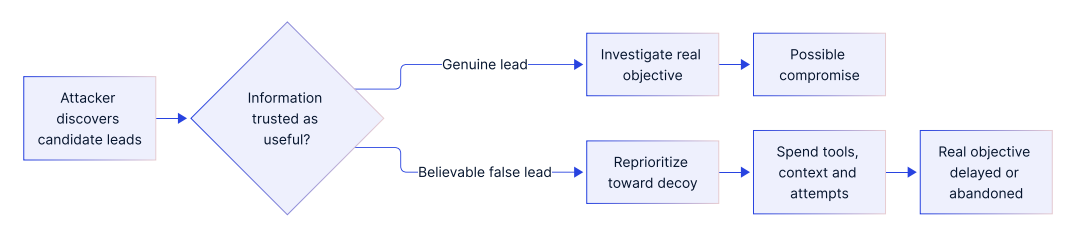
This is a different defensive mechanism from instruction injection. Instead of trying to seize control of the agent, the defender alters the evidence on which its plan is based.
It also creates a different failure mode: fabricated context must never contaminate genuine business decisions, production datasets, or the defender's own automated analysis. Mark, isolate, and govern deceptive material internally even when it must appear authentic to an intruder.
3.4. Reverse deception: make the valuable asset look suspicious
Most deception techniques make fake assets appear real. Reverse deception does the opposite: make a real asset appear to be a trap so that a cautious attacker avoids it.
The underlying idea is older than agentic AI. More recent tests make it worth revisiting: Tracebit reported that a false pentest report labeling genuine targets as canaries reduced successful runs in one configuration from 39 of 40 to 2 of 40.
This is an intriguing result, not a substitute for hardening. An attacker with a specific mission, or a human operator willing to accept risk, may investigate anyway. And if the attacker leaves, the defender may receive no detection signal at all.
Enterprise implication: treat this as experimental protection for selected high-value paths, not as a primary sensor or security boundary.
3.5. Fingerprinting: use the interaction to learn about the attacker
A decoy can be useful without persuading the attacker to perform a harmful action. It can create a controlled interaction that reveals characteristics of the attacking agent.
The Say Shibboleth research reported approximately 90% top-choice accuracy identifying a model among 15 candidates, and 92% for the attacking harness, in its experimental setup. One illustrated mechanism is a fake tool that requests information as part of an apparently legitimate workflow.
Attribution here is probabilistic. A research fingerprint should not be treated as proof of an actor's identity, nor should model identification alone justify account-blocking or other consequential action. It can, however, enrich incident investigation and help compare repeated campaigns.
4. From catching an attacker to interrupting the attack
The old deception success criterion was often simple: did someone touch the honeypot?
For agentic attackers, the more useful question is what changed in the attack workflow because the decoy existed? A realistic clone can absorb exploitation attempts. Misleading context can waste effort. A decoy key can reveal an attempt to validate stolen credentials. Reverse deception may deter an opportunistic agent altogether.
A decoy hit is valuable precisely because it can be highly specific. But high specificity is not universal: a canary may be triggered by a legitimate scanner, misconfiguration, or test. The response should therefore be governed by context and impact.

The important boundary is between AI-assisted investigation and authority to act. Containment should be implemented through explicit policy, scoped credentials, and auditable playbooks. A model should not be able to grant itself permission to isolate a production service.
This is where deception becomes a useful part of security operations rather than an isolated experiment. The interaction yields a signal; the response logic determines whether to enrich, investigate, revoke, quarantine, or simply observe.
5. What the research actually demonstrates
| Research | Defensive effect tested |
Reported result |
Important limitation |
|---|---|---|---|
|
Gingerbread House |
Divert agent to realistic application clone |
Claude Opus 4.8: 26/40 successful tasks without defense 1/40 with stronger configuration |
Experimental tasks; source access; no simple-block comparison |
| Honeyval | Keep agents engaged with realistic responses |
Agent engagement: ~83 requests for LLM decoys 31 requests for rule-based decoys |
Decoy detection depends on latency and implementation |
| Tracebit | Redirect attacker planning through contextual deception |
Compromising runs: 99% without deception 19% with deception |
Vendor study; one AWS environment; model-dependent |
|
Say Shibboleth |
Fingerprint attacking model and harness |
Identification accuracy: ~90% model ~92% harness |
Research setting; not definitive actor attribution |
These studies ask different questions and cannot be ranked by their percentages. The defensible conclusion is narrower: several forms of deception materially changed agent behavior in controlled experiments, with realism and deployment context strongly influencing the outcome.
6. Enterprise defense: three prioritization bundles
| Priority bundle |
What to implement |
Why it matters |
Evidence to look for |
|---|---|---|---|
| A. Deploy deception that works today |
Private honeytokens; decoy secrets, identities, and resources on plausible attack paths; realistic, isolated services |
Turns reconnaissance and credential validation into useful signals without relying on the agent obeying injected instructions |
Canaries are not trivially fingerprinted; authorized tests trigger reliably; legitimate activity does not |
| B. Connect deception to governed response |
SIEM/SOC enrichment; identity and workload correlation; policy-gated token/session revocation; controlled diversion |
Converts a decoy interaction into an opportunity to interrupt progress | Response is scoped, auditable, reversible where possible, and tested against false positives |
| C. Validate emerging agent-aware techniques |
Context deception; high-fidelity shadow routing; fingerprinting; carefully scoped reverse deception |
Tests whether defenses can divert or deter agents that recognize traditional traps | Repeatable adversarial evaluations show objective denial without production contamination or unsafe side effects |
These bundles are not a mandatory sequence. A is the practical baseline; B increases operational effect; C is the controlled experimentation track. For critical environments, isolation and response governance are prerequisites to any active diversion into a clone.
7. Where cyber deception is heading
7.1. From static traps to functioning environments
The more an attacker verifies what it sees, the more valuable coherent behavior becomes. Realistic applications and responsive services may outperform simplistic imitations, but bring genuine engineering and isolation costs.
7.2. From generic bait to environment-specific context
A convincing decoy is built around what an attacker would actually expect to find in that enterprise. That favors private credentials, credible application artifacts, and attack-path-informed placement over publicly recognizable templates.
7.3. From deployment to continuous adversarial validation
The attacker will adapt. Models may recognize yesterday's lure or skip anything that looks artificial. Organizations should periodically test their deception with authorized, isolated offensive agents and retire mechanisms that have become obvious or disruptive.
One legal and operational boundary remains essential: misdirection within systems you control is different from executing code on an attacker's machine or attempting unauthorized access to its infrastructure. Active countermeasures require jurisdiction-specific legal review. Deception content must also be contained so that defenders, employees, and automated systems do not mistake it for genuine operational data.
8. The best trap may no longer look like a trap
The story is not that honeypots are dead, nor that defenders have discovered a universal trick for defeating AI agents.
It is that deception is becoming a way to shape an attacker's choices.
A realistic clone redirects execution. A convincing false lead consumes effort. A private token reveals credential validation. A carefully governed response uses that signal to stop progress. In selected settings, merely appearing to be a trap may cause an opportunistic attacker to walk away.
That is a more useful design goal than collecting another honeypot alert: make the attacker's route to a real objective less reliable, more expensive, or unavailable, while keeping the defensive mechanism controlled and testable.
For enterprises preparing for agentic offensive security, the next question is not simply “Do we have honeypots?” It is “Where in the actual attack path can deception change the outcome?”
SPARK42 examines AI-assisted offensive security and the defensive architecture needed to withstand it. The focus is on evidence, controlled execution, and security outcomes rather than autonomous-security marketing claims.